Barbara H
Aboard the Barbara H
A walk from the engine room to the wheel, as visitors made it at festival landings between 2001 and 2012.
The first surprise aboard is where the engine sits. In a steamboat the engines lie at the stern, beside the wheel they turn. In the early diesel sternwheelers the engine was set well forward and the power sent aft, and the Barbara H is the last towboat to keep that arrangement. Hers is a four-cylinder Fairbanks-Morse 35E10, built at Beloit, Wisconsin, in the summer of 1940, with a ten-inch bore, a twelve-and-a-half-inch stroke and 160 horsepower at 400 revolutions a minute. The history gives its weight as 10,000 pounds; the survey notes of 2005 say nearer 25,000.
It is a direct-reversing engine. There is no reverse gear: to back the boat, the engineer stops the engine and starts it again turning the other way, on compressed air from tanks holding 250 gallons. The same air blows the two whistles. From the engine a shaft and a massive double roller-chain carry the power to the paddlewheel, which is why boats of this kind were called bicycle boats.
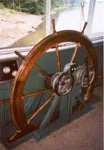
The pilothouse is reached from the roof. Its wheel is original, nearly seven feet across, made of white oak spokes and red oak rim, and it works five rudders: three flanking rudders ahead of the paddlewheel, which steer the boat when she backs, and two monkey rudders behind it. Boats built a few years later were steered with levers, and the big wooden wheel went out of use on the rivers in the 1930s.
The cabin is wood on a steel hull, lap-sided and painted white, and it is the cabin she was built with. Along the hull runs a rub-rail made from the return flue pipes of the steam towboat Sam Craig. Below are tanks for 3,000 gallons of diesel fuel and 150 of fresh water, and a 16-kilowatt generator driven by a small Perkins diesel supplies the lights and the galley.
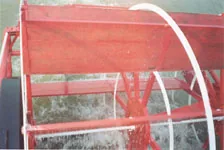
Out on the fantail the wheel carries ten buckets, each of three white-oak planks bolted to steel arms and painted red. The planks were renewed in 2001; the old ones had been in the river since at least 1982.